From its foundation, Transylvania has been an eclectic mix of ethnicities and religions. Throughout its history, it has belonged to a variety of empires and states, including the Dacia, the Romans, the Huns, the Byzantine Empire, the Bulgarians, the Austro-Hungarian Empire, and the Romanians. Different ethnic and religious groups have vied for prominence in Transylvania during these ages. After a sixteenth century marked by conflict between the Muslim Ottoman Empire and the Catholic Hapsburg Empire, Transylvania became a semi-independent principality. Once Transylvania was relieved of the pressure of the Catholic Hapsburgs, other religions had the freedom to flourish. In 1568, the Edict of Turda guaranteed freedom of religious expression—the first legal guarantee of religious freedom in Christian Europe—for Lutherans, Calvinists, Unitarians, and Catholics.
Following the Edict of Turda in the 16th century, the Ottoman Sultan Suleiman the Magnificent overtook central Hungary. For the next two centuries, Austria and Turkish forces vied for supremacy in a now semi-independent Transylvania. Because Transylvania now existed outside of Catholic religious authority, Calvinist and Lutheran teachings flourished in the region. On the other hand, Orthodoxy, the Romanian religious tradition, was “tolerated” or banned altogether.
Historically, Transylvania exists as a region of continual change. With various powers and governments in constant conflict over power and authority in this region, the amount of religious tolerance is actually quite surprising. In stark contrast to tolerance, religious practices were harshly monitored and controlled under the all-encompassing communist regime from WWII to the Romanian revolution of 1989. Religious structures and educational institutions were controlled by the government, just as every facet of life under communist rule.
Leah, Alison, Rachelle, Sam
Friday, October 10, 2008

The Legacy of Communism: The Breakdown of Religious Life
Prior to the 20th century Soviet rule in Transylvania the church as an institution fulfilled many roles. Not only was the church responsible for many public service establishments such as schools, orphanages and hospitals, it more specifically provided an identity for the Transylvanian people, a community to relate to and associate with. Many villages in Transylvania were even built around a church, placing the church literally in the center of peoples’ lives. When the Soviets came to power after WWII, the church was one of the first bodies to be reformed. Because different denominations divided people, the communists saw this take over as a method of standardization. The Transylvanian people looked more to the state for the basis of their identity. A large percentage of church property was taken over by the state.
Under Communist rule industrialization increased which forced many Transylvanians to migrate to urban areas. This increased movement to cities resulted in reduced populations in small towns and villages. Church congregations suffered significant losses because so many parishioners were leaving. Many church buildings in Transylvania today remain deserted, a repercussion of the Soviets’ industry-focused economic plan.
In the United States, if a congregation dissipates, the church leaders might sell the building and move to a more populated area. In Transylvania, this is unacceptable. There is a social expectation that a church will remain in its historic space, even if nearly all of its members no longer live nearby. The thought of a pastor abandoning the building of a church and moving to more urban areas to form a new church would never be admissible. Also, the church building itself is regarded with more reverence and holds more significance to the people in Transylvania than is customary observed in the United States. This also contributes to the vast number of empty churches in Transylvania.
Despite the end of communist rule twenty years ago, the church’s position in society remains unstable. The state is still redistributing properties of the church that were taken over during Soviet rule. The view of denomination as an identifier has been nearly eliminated. People today are going to church but no longer feel the obligation to remain loyal to the denomination they were raised in.
(Catherine Van Halsma, Kristin Kurtz and Liz Yeager)
Under Communist rule industrialization increased which forced many Transylvanians to migrate to urban areas. This increased movement to cities resulted in reduced populations in small towns and villages. Church congregations suffered significant losses because so many parishioners were leaving. Many church buildings in Transylvania today remain deserted, a repercussion of the Soviets’ industry-focused economic plan.
In the United States, if a congregation dissipates, the church leaders might sell the building and move to a more populated area. In Transylvania, this is unacceptable. There is a social expectation that a church will remain in its historic space, even if nearly all of its members no longer live nearby. The thought of a pastor abandoning the building of a church and moving to more urban areas to form a new church would never be admissible. Also, the church building itself is regarded with more reverence and holds more significance to the people in Transylvania than is customary observed in the United States. This also contributes to the vast number of empty churches in Transylvania.
Despite the end of communist rule twenty years ago, the church’s position in society remains unstable. The state is still redistributing properties of the church that were taken over during Soviet rule. The view of denomination as an identifier has been nearly eliminated. People today are going to church but no longer feel the obligation to remain loyal to the denomination they were raised in.
(Catherine Van Halsma, Kristin Kurtz and Liz Yeager)
The Legacy of Communism: The Breakdown of Rural Life
Marxist theology holds that urban areas are economically, socially, and culturally superior; forty years of communist rule in Romania marked fundamental economic, social, and cultural shifts reflective of this overarching ideology.
One of the greatest shifts occurred through the breakdown of rural life. The communist regime focused its interest on industrialization, especially during the Ceausescu era (1965-1989), and agricultural production was largely underfunded. But even farms were organized to profit the communist economic machine as the state forced collectivization of farms throughout Romania; by the 1980s, eighty percent of Romania’s farms were owned by the state and organized as collectives. Collective farmers received wages, a portion of the profit, and some farm products, but were no longer landowners. This program of forced collectivization was intended the boost agricultural production, but in reality, it led to sweeping drought and famine and a dwindling, disenchanted rural labor population.
As conditions worsened in rural areas, the disparity between rural and urban life widened into a gaping chasm; parents urged their children to seek educational and vocational opportunities in the cities, and many young adults joined the great tide of people flooding into city centers. The rural population shriveled quickly during this rural-urban migration, and rural populations were soon comprised of mainly women, children, and the elderly. (This was evident to our group as we bumped along through the Romanian villages; we saw mostly women and elderly people.)
With the flood of people headed for the city, the government started looking for a way to ease this great strain on cities; the regime was also looking for further opportunities to extend the machine of industrialization into rural areas in Romania. Through a program of systematization, Nicolae Ceausescu tried to stem the overwhelming tide of people migrating to the cities and to aid the machine of communist industrialization in Romania. Ceausescu poured money and resources into 550 Romanian villages, carefully selected for their industrial potential; these villages underwent a large-scale upheaval that transformed housing and education and implemented new industries to fuel the communist regime. Efforts for modernization and industrialization were concentrated in these areas while over 3,000 other villages were labeled “nonviable” and were gradually phased out or forcibly dissolved to make way for industrialization.
Great changes in village life threatened rural communities, and those who moved to the cities were completely estranged from their roots, cut off from any home or church community that formerly defined their identity. In order to remove nongovernmental spheres of influence and to extend social and ideological control over the Romanian people, the communist regime took public education out of the religious sphere and also demolished many churches. The destruction of so many churches and villages severed many people’s cultural and historical bonds and threatened the solidarity of their communities.
(Leah, Bethany, Rachelle)
One of the greatest shifts occurred through the breakdown of rural life. The communist regime focused its interest on industrialization, especially during the Ceausescu era (1965-1989), and agricultural production was largely underfunded. But even farms were organized to profit the communist economic machine as the state forced collectivization of farms throughout Romania; by the 1980s, eighty percent of Romania’s farms were owned by the state and organized as collectives. Collective farmers received wages, a portion of the profit, and some farm products, but were no longer landowners. This program of forced collectivization was intended the boost agricultural production, but in reality, it led to sweeping drought and famine and a dwindling, disenchanted rural labor population.
As conditions worsened in rural areas, the disparity between rural and urban life widened into a gaping chasm; parents urged their children to seek educational and vocational opportunities in the cities, and many young adults joined the great tide of people flooding into city centers. The rural population shriveled quickly during this rural-urban migration, and rural populations were soon comprised of mainly women, children, and the elderly. (This was evident to our group as we bumped along through the Romanian villages; we saw mostly women and elderly people.)
With the flood of people headed for the city, the government started looking for a way to ease this great strain on cities; the regime was also looking for further opportunities to extend the machine of industrialization into rural areas in Romania. Through a program of systematization, Nicolae Ceausescu tried to stem the overwhelming tide of people migrating to the cities and to aid the machine of communist industrialization in Romania. Ceausescu poured money and resources into 550 Romanian villages, carefully selected for their industrial potential; these villages underwent a large-scale upheaval that transformed housing and education and implemented new industries to fuel the communist regime. Efforts for modernization and industrialization were concentrated in these areas while over 3,000 other villages were labeled “nonviable” and were gradually phased out or forcibly dissolved to make way for industrialization.
Great changes in village life threatened rural communities, and those who moved to the cities were completely estranged from their roots, cut off from any home or church community that formerly defined their identity. In order to remove nongovernmental spheres of influence and to extend social and ideological control over the Romanian people, the communist regime took public education out of the religious sphere and also demolished many churches. The destruction of so many churches and villages severed many people’s cultural and historical bonds and threatened the solidarity of their communities.
(Leah, Bethany, Rachelle)
Region and History of Settlement since 900

The history of Transylvania, like so many other Eastern European regions, is full of constant invasion and transformation. In 900 AD Magyar (Hungarian) tribes invaded Transylvania which was inhabited by a mix of Slavs and Romanians. During this time medieval Transylvania was ruled by a system of regional military commanders that acted for the King of Hungary. In 1200 AD the Magyars invited Germanic peoples (now known as Saxons) to Transylvania to establish trading cities. In 1241 Transylvania was devastated in the Mongol invasion of Europe and a large portion of the population perished. In the centuries following this time the Magyar nobility and the Saxons dominated the feudal system as peasant Magyars and Romanians continued to be suppressed. In 1541 the Ottomans defeated Hungary and left Transylvania as the only remaining area of Magyar control, until the Austrian Hapsburg's Empire regained Hungary and Transylvania in 1691. In 1867, under the dual monarchy of the Austro-Hungarian Empire, Transylvania became part of Hungary for the first time. As Magyar settlements and peoples continued to inhabit the region, many Romanians moved to Moldavia to escape the hardships of being a peasant serf.
After WWI, the Treaty of Versailles gave Transylvania back to the Romanians defining a new border between Hungary and Romania. In 1940 the northern half of Transylvania was again given back to Hungary till the end of WWII when it was again returned to Romania. Most of the Saxons living in Transylvania returned to Germany after WWII and the fall of communism, making Hungarians the largest minority group. In some regions the Hungarians outnumber the Romanians creating tension over autonomy.
(Lydia, Paul and Liz)
Thursday, October 9, 2008
Issues in Maintaining Spiritual Life of Rural Communities: Nationalism and Religion
Congregations throughout
Barriers such as aging and shrinking congregations already threaten the life of the churches throughout
Some churches have made strides however to welcome or at least interact with people of minority nationalities. The Catholic Church, while still predominately Romanian, has made attempts to partner in some respects with the Armenian Church in
The Romanian government in some ways has helped churches in revitalizing the spiritual lives of Transylvanians and in other ways has harmed their ability to do so. Many rural churches receive funding from the state for various purposes, one of which is to create or maintain schools. The churches’ ability to oversee education does assist the churches in sharing its principles with the youth. Yet, the specific allocation of funds continues to drive a wedge between the denominations. The requisite number of ethnic Romanian children necessary to garner state money and create a church run school teaching solely in the Romanian language and about Romanian customs is rather low. Much higher numbers of Hungarian students are needed for schools run by Reformed churches in rural areas to receive government assistance. Thus, there are very few Hungarian schools in rural
(Sarah, Jordan, Paul)
Differences in Church Building Styles
A few, sometimes obvious and sometimes minor, differences exist among the building styles of Reformed, Roman Catholic, and Orthodox churches in Transylvania . Each denomination has a distinct fixture atop the bell towers or steeples to signify the faith practiced there. Orthodox churches don arched crosses, Roman Catholic churches utilize plain crosses, and Reformed churches sport stars. Another more readily apparent stylistic variance occurs between Western Christian and Eastern Orthodox church buildings. The architecture and facades of Orthodox churches are often times more ornate. Of the Orthodox churches we visited and drove past, many exteriors were painted or tiled with images of holy figures. Also, in particular, architectural design of the largest Orthodox church we encountered differed significantly from the more typical style, discussed below, being equipped with several domes and having a more unique layout. It should be noted however that in general churches of all denominations located in cities tend to be larger and more decorative in designs both outside and within.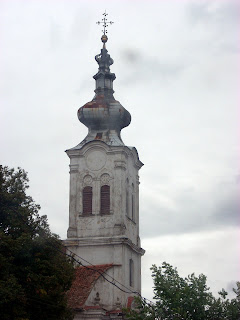
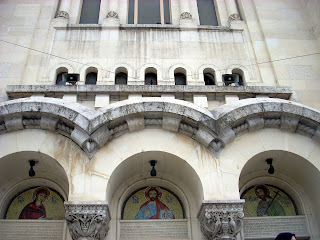
Exterior Decorations of Orthodox churches
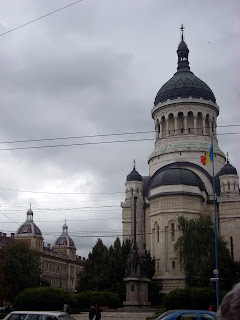 Domes of Orthodox church


Fortification
 Inside Bell Tower


 Gothic Style

Catholic

Reformed


Exterior Decorations of Orthodox churches
 Domes of Orthodox church
 Despite these differences many noticeable commonalities are shared among many churches throughout Transylvania . To begin, many churches were built as in a rectangular fashion with a triangular roof and a bell tower jutting forth. Bell Transylvania , especially those on the grander scale. Key features of which are ribbed vaults, an emphasis on verticality and light, and pointed arches. The preference toward vertical structures is shown in the fact that many churches appear to be much taller than they are wide, thanks to bell towers. Furthermore, churches’ windows are typically large in scale yet narrow in width.


Fortification
 Inside Bell Tower


 Gothic Style
By Debbie, Brianna, and Sarah
Church Seating Patterns and Confirmation Class Decorations
Hungarian churches of Transylvania have very characteristic seating patterns that reflect not only their religious but also their cultural traditions. The seating arrangement is centered around the pulpit, emphasizing theology and teaching over iconography. Typically men and women sit in separate sections facing one another while the elders hold a more prominent position in pews either in front or behind the pulpit. Until parents decide they are ready to join the rest of the congregation, children sit in the balcony of these giant churches.


Consistent with the Reformed tradition, Hungarian Romanian churches keep decorations simple yet meaningful. Members of the church donate handmade embroideries to commemorate both individual and communal spiritually significant events. These embroideries are painstakingly made and part of the proud cultural heritage of these churches. The colors and designs reflect the communities in which they were made. Confirmations of faith are the most common reasons for these gifts to the church.


(Elizabeth W, Stephanie, Alison)
Subscribe to:
Posts (Atom)